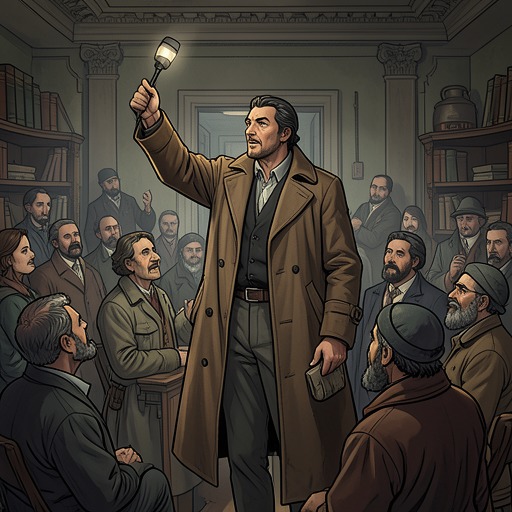
James Murray and Frederick Furnivall
The Surgeon of CrowthorneThe relationship between James Murray and Frederick Furnivall joined two complementary forces in the making of the New English Dictionary: Furnivall’s energetic sponsorship and Murray’s scholarly discipline. Furnivall recognized Murray as the editor the failing project needed, promoted him to the Society and to Oxford, and helped secure the decision that allowed the dictionary to proceed. Their association was not without friction or imbalance, but its practical consequence was decisive: Murray took charge of the work and began rebuilding its volunteer effort.
Intellectual Formation and Introduction
Murray’s rise into serious philology had begun through other scholarly connections. Friendship with Alexander John Ellis and Henry Sweet helped turn his interest from that of an enthusiastic amateur into sustained scholarly work. Though he had left school at fourteen and had not attended university, he entered the Philological Society and joined its Council in 1869. By the time he encountered Furnivall, Murray had established himself through scholarship rather than conventional academic credentials.
In 1873, while teaching again at Mill Hill School after leaving the bank, Murray published The Dialect of the Southern Counties of Scotland. The book won wide admiration and brought an invitation to contribute an essay on the history of the English language to the ninth edition of the Encyclopaedia Britannica. It also brought him into contact with Furnivall, the Philological Society’s secretary. For Murray, this was more than an introduction to an influential society figure: Furnivall would become a persuasive advocate whose judgment helped redirect the dictionary project toward a viable editor and publisher.
A Powerful, Uneven Influence
Furnivall was a difficult figure to work with. His outspoken attacks on religion and class distinctions, lack of tact, and readiness for controversy had alienated editors and publishers; some regarded him as socially reprehensible. Yet the same man was a brilliant scholar with an intense appetite for learning. The account describes him as a dynamic, powerful influence on Murray, stimulating and persuasive, but also meddlesome and exasperating. Their importance to one another therefore rested not on identical temperaments, but on the force of their intellectual engagement and the work Furnivall could do on Murray’s behalf.
Furnivall’s influence also extended beyond personal encouragement. He had a prominent place in Victorian philology and was a natural choice to take a leading role in the new dictionary. But commitment and energy did not make him an effective project leader. The volunteer effort he presided over ebbed: readers stopped sending quotation slips, and in 1879 alone two tons of books and papers were returned. The contrast between Furnivall’s gifts and his limitations explains the practical shape of his relationship with Murray. Furnivall could keep the enterprise in view and identify the person to lead it, even when he could not sustain its day-to-day momentum himself.
Sponsorship and the Search for a Publisher
As the dictionary stalled, Furnivall judged Murray to be the right editor and approached him, along with other Society members, to advocate his candidacy. Murray was then just over forty, had returned to teaching at Mill Hill School, and had already built a record in Scottish dialect, the editing of Scottish poetry, and ambitious scholarly projects. Furnivall’s proposal joined that record to a larger institutional possibility: Oxford University Press had academic standing, deeper resources than the Society, and a comparatively flexible view of the time a major literary undertaking might require.
Murray was persuaded to prepare specimen pages to show how the dictionary might work. He selected arrow, carouse, castle, and persuade. Furnivall continued canvassing other publishers and printers, while Oxford’s Delegates challenged the specimens: they questioned whether Murray had gathered enough quotations, objected to his presentation of pronunciation, and debated whether the etymologies belonged in the work. When Cambridge University Press rejected the proposal, Oxford remained the principal possibility. Furnivall’s persistence kept the project before prospective publishers; Murray’s specimens gave them a concrete editorial plan to judge.
From Advocacy to Editorial Partnership
On 26 April 1878, Murray travelled to Oxford to meet the Delegates of Oxford University Press. He expected to be intimidated, and they expected they might dismiss him. Instead, the meeting produced a surprising mutual liking and a decision to proceed, marked by subdued celebration over dry sherry. Furnivall’s friendship and sponsorship, alongside Murray’s scholarly connections with Ellis and Sweet, had helped bring about this turning point. The dictionary’s prospects changed from a project widely thought unlikely to be carried out into a work Oxford was willing to support.
Agreement did not settle the terms at once. Contract negotiations lasted another year and were often bitter; Murray, described as other-worldly, rarely conducted them in person, while his wife took a more hard-headed part. On 1 March 1879, the formal agreement made Murray editor on behalf of the Philological Society and projected a dictionary of about 7,000 quarto pages in four volumes, to be completed in ten years. The estimate proved far too short, but the work had at last begun properly.
Furnivall’s and Murray’s roles then diverged without separating their shared undertaking. Within days, Murray planned a corrugated-iron Scriptorium in the grounds of Mill Hill School and issued a four-page appeal for readers across Britain, America, and the British colonies to resume extracting quotations. Furnivall had helped identify the editor and secure the institutional opening; Murray now gave the project a working base and renewed its public call for assistance. Their relationship mattered because it converted advocacy into an editorial appointment—and an appointment into a dictionary project that, this time, would not stop.